
MDF and IDF architecture
Plan main and intermediate distribution frames around building layout, pathway distances, rack space, structured cabling, power, and UPS runtime requirements.
Fiber Optic & Campus Infrastructure Design Consulting
I design fiber backbones and network closets for campuses, warehouses, and distribution centers. I produce topology, pathway, and capacity plans that your installation contractors can build and your network team can operate.
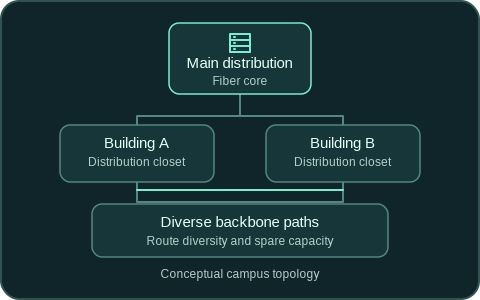
Separate uplinks may share a conduit or entrance, so a single cut can still take both paths down.
An expansion needs more links, but available strands, reach, and transceiver compatibility limit the design.
Additional access switches or APs put pressure on rack space, copper pathways, power, and UPS runtime.
Plan main and intermediate distribution frames around building layout, pathway distances, rack space, structured cabling, power, and UPS runtime requirements.
Design redundant fiber ring or diverse-path topologies for building-to-building connectivity. Coordinate physical route diversity with switching and failover design.
Evaluate single-mode and multimode fiber for reach and capacity. Document strand assignments, spare capacity, and expansion options.
Assess bidirectional (BiDi) optics and coarse wavelength-division multiplexing (CWDM), including optical add/drop multiplexers. Check wavelength plans, platform support, and optical budgets.
Map Cisco switch ports, compatible transceivers, speeds, and logical uplinks to the physical fiber plan. Define how your network team will verify links and failover.
Document topology, pathway and termination requirements, labeling, and acceptance criteria. Sequence expansions around live warehouse and distribution operations.
Route diversity helps keep alternate paths available after a cable failure. A strand and wavelength plan shows where existing fiber can support more links and where new capacity is needed. Clear handoff documents help contractors build to the design and operators trace links later.
I’m Chris Hurst, an independent engineer with about 10 years of hands-on enterprise networking experience, including several years as a lead network engineer. I deliver most engagements remotely and stay involved from design and troubleshooting through implementation and handoff.
I focus on the engineering design, including the relationship between fiber routes, optical limits, and switch behavior. Your installation contractors handle placement, termination, and physical testing.
Yes. I can review fiber records and available test results, then assess whether the installed strands, reach, and loss budgets support the proposed links.
They can be useful when spare strands are limited. The choice depends on link count, reach, optical budget, compatible optics, and the level of complexity your team wants to operate.
Your installation contractor handles the physical work and testing. I can define the design and acceptance requirements and review the results with your team.
Related services: Enterprise Network Engineering, Enterprise Wireless Networking, Warehouse network design, Illustrative warehouse architecture
Tell me what you’re working on or what you’d like to know. I’ll review your note and follow up about the next step.
For a project that needs more context, use the full consultation form.