
Identify the caller and location
Ask for a name, confirm the relevant business location, and use approved records to look up a match when appropriate.
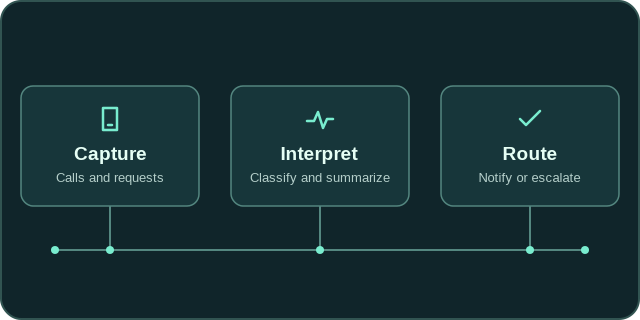
Collect useful information when your team can’t answer, then route the request to the right person for follow-up.
For a service business whose staff are often with customers or in the field, overflow or after-hours calls are a practical starting point. A voice agent can ask what the caller needs and give your team enough information to decide what to do next.
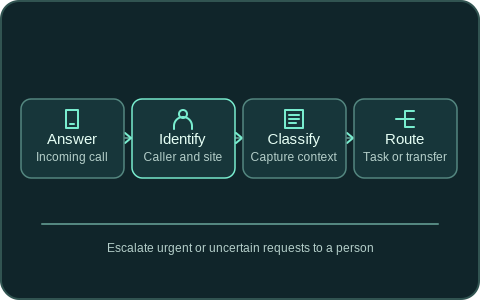
Ask for a name, confirm the relevant business location, and use approved records to look up a match when appropriate.
Use follow-up questions based on the type of request, and capture the answers as structured fields your team can review.
Create a summary, notify the right staff member, and pass approved details to a CRM or other business application.
Define when to transfer a call or request a callback, including urgent requests, uncertain answers, and callers who ask for a person.
I’ve developed a telephone answering and workflow system using Retell AI, including conversational intake, request classification, and application integration. Some capabilities remain in development and have yet to be validated in production.
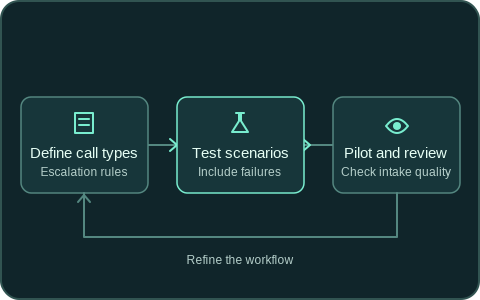
For a new engagement, I start with call types, the information staff need, and what should trigger escalation. We define what the agent can say, how callers are informed, what information is collected, who can access it, and what happens when a transfer or integration fails.
Before routing real calls, test representative scenarios, including interruptions, ambiguous answers, missing records, failed transfers, and unusual requests. A limited rollout gives staff a chance to review intake quality and adjust the workflow before expanding it.
An answering workflow can help capture opportunities that would otherwise go to voicemail, reduce manual note-taking, and get requests to the right person faster. For simple routing or a small number of predictable call types, a conventional phone menu or callback queue may be easier to operate.
Explore AI and business automation for related intake and workflow work, or describe how your team handles calls today.
For businesses that miss calls after hours or spend time retyping caller details. Start with one call scenario on a test number or a single agreed queue. Define the details staff need, which system receives the request, and when to hand off to a person.
We configure the workflow and test clear matches, ambiguous locations, incomplete details, and unavailable transfers. Staff review the notifications and sign off on the required fields, routing rules, and fallback before any live rollout.
You get the configured pilot, test findings, and a recommendation on whether to expand. Platform usage, additional integrations, production deployment, and ongoing management can be scoped separately.
Discuss an AI Voice PilotTwo fictional calls to a multi-location equipment service business. Names, locations, and records are synthetic. These are illustrative examples, not customer recordings or production results.
Agent: “Thanks for calling Sample Equipment Service. Who’s calling, and which location needs service?”
Caller: “Jordan Vale from Example Foods. It’s our North branch. Our prep cooler is warming up. Please call before we open at 7.”
Agent: “I found Example Foods North. Is that the branch on Sample Avenue, and is 202-555-0142 the best callback number?”
Caller: “Yes.” Agent: “I’ll send that to the service desk for review. I can’t confirm a technician or arrival time.”
Caller: “This is Casey from Example Foods. The walk-in won’t cool at the new store.”
Agent: “I found two locations and can’t verify which store you mean. Do you know the street or store number?”
Caller: “No. Call me at 202-555-0187.”
Agent: “I’ll ask the service desk to confirm the location with you before assigning the request.”
Thinking about using AI to answer calls, help customers, schedule appointments, or automate business workflows? Try a real AI assistant and explore what it could do for your business.
You’re chatting with AI. Retell processes the conversation and may retain it for operation and quality review. Leave out passwords, credentials, payment information, medical records, and other sensitive information. Chat requires no registration, email address, or payment. Your project goes to Chris only if you explicitly send it. See the privacy policy.
Tell me what you’re working on or what you’d like to know. I’ll review your note and follow up about the next step.
For a project that needs more context, use the full consultation form.